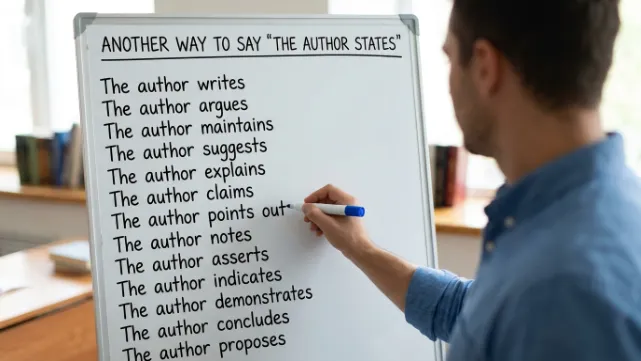
When you write essays, articles, or research papers, you often need to refer to what an author says. But repeating the same phrase like “the author states” again and again can make your writing feel flat and boring.
That is why learning different ways to express this idea is very important. It helps you sound more natural, more skilled, and more interesting. It also helps you match your tone to different types of writing like academic work, journalism, storytelling, or short summaries.
In this guide, you will learn many powerful alternatives to “the author states.” Each section will show you how to use them in different situations with clear examples. Everything is written in simple, easy English so you can use it right away.
Academic Writing and Essays: Formal Ways to Say the Author States
In academic writing, you need clear, formal, and precise language. These phrases help you sound professional in essays, research papers, and reports.
- the author argues that
- the author explains that
- the author suggests that
- the author claims that
- the author observes that
- the author notes that
- the author highlights that
- the author emphasizes that
- the author points out that
- the author discusses that
- the author presents the idea that
- the author puts forward the idea that
- the author indicates that
- the author concludes that
- the author believes that
- the author maintains that
- the author reports that
- the author describes that
- the author identifies that
- the author reveals that
- the author supports the idea that
- the author demonstrates that
These phrases help you sound more academic and less repetitive. For example, instead of saying “the author states that climate change is real,” you can say “the author argues that climate change is real,” which sounds stronger and more analytical.
Journalism and Reporting: Neutral and Clear Alternatives
In journalism or news writing, clarity is the most important thing. You need phrases that are simple, direct, and easy for readers to understand quickly.
- the author reports that
- the author writes that
- the author says that
- the author informs that
- the author shares that
- the author confirms that
- the author notes that
- the author reveals that
- the author highlights that
- the author updates that
- the author mentions that
- the author explains that
- the author adds that
- the author comments that
- the author states clearly that
- the author provides details that
- the author tells readers that
- the author points out that
- the author describes that
- the author publishes that
- the author communicates that
- the author delivers information that
These options are useful when you want to report facts without adding opinion. For example, “the author reports that prices have increased” sounds clean and factual.
Creative, Emotional, and Fun Expressions
Sometimes writing needs personality. In storytelling, blogs, or informal writing, you can use more expressive and emotional phrases to make your writing engaging.
- the author brings up that
- the author opens with the idea that
- the author dives into the idea that
- the author paints a picture of
- the author unfolds the idea that
- the author walks us through
- the author takes us into
- the author shares the thought that
- the author breaks down the idea that
- the author builds on the idea that
- the author shines light on
- the author opens the door to
- the author invites readers to see that
- the author makes it clear that
- the author sets the stage for
- the author explores the idea that
- the author zooms in on
- the author expands on
- the author connects the idea that
- the author brings attention to
- the author draws focus to
- the author shows us that
These phrases make writing feel more alive. For example, instead of a plain sentence, you can say “the author opens the door to a new understanding of human behavior,” which feels more engaging and visual.
Smart Ways to Say the Author States in Academic Writing
- the author argues that
- the author explains that
- the author suggests that
- the author claims that
- the author observes that
- the author notes that
- the author highlights that
- the author emphasizes that
- the author points out that
- the author discusses that
- the author presents that
- the author puts forward that
- the author indicates that
- the author concludes that
- the author believes that
- the author maintains that
- the author reports that
- the author describes that
- the author identifies that
- the author reveals that
- the author supports that
- the author demonstrates that
Easy Alternatives to the Author States You Can Use Today
- says that
- states that
- notes that
- writes that
- explains that
- mentions that
- tells that
- shows that
- finds that
- reports that
- adds that
- claims that
- argues that
- believes that
- highlights that
- points out that
- confirms that
- describes that
- reveals that
- discusses that
- observes that
- suggests that
Improve Your Writing With Better Ways to Say the Author States
- the author brings up that
- the author opens with that
- the author dives into that
- the author paints a picture that
- the author unfolds that
- the author walks us through that
- the author takes us into that
- the author shares that
- the author breaks down that
- the author builds on that
- the author shines light on that
- the author opens the door to that
- the author invites readers to see that
- the author makes it clear that
- the author sets the stage for that
- the author explores that
- the author zooms in on that
- the author expands on that
- the author connects that
- the author draws focus to that
- the author brings attention to that
- the author shows us that
Short and Simple Alternatives: Quick Options for Fast Writing
When you need quick summaries, notes, or simple sentences, short phrases work best. These are perfect for students, captions, or quick explanations.
- says that
- states that
- notes that
- explains that
- writes that
- mentions that
- tells that
- shows that
- finds that
- reports that
- adds that
- claims that
- argues that
- believes that
- highlights that
- points out that
- confirms that
- describes that
- reveals that
- discusses that
- observes that
- suggests that
These short forms are easy to use and help you write faster without losing meaning.
Tips for Using Alternatives to the Author States
Here are some smart tips to improve your writing even more:
- Match tone with purpose — use formal phrases for essays and simple ones for notes
- Avoid repetition — switch phrases every few sentences to keep writing fresh
- Choose strong verbs — words like argues or reveals add more meaning than states
- Think about clarity — do not use complex phrases if simple ones work better
- Read your sentence out loud — if it sounds natural, it is usually correct
Conclusion
Learning different ways to say “the author states” is a small change that makes a big difference in writing. It helps you avoid repetition, improve clarity, and match your tone to different types of writing.
If you are writing an essay, a news article, or a creative blog, you now have many options to choose from. The key is to pick the phrase that best fits your context and your message.
Try using a few of these alternatives in your next piece of writing. Notice how your sentences become more natural and engaging.
What new phrase will you try first in your writing?
Discover More Article
- 🎯 Another Way to Say Emphasizes in English Writing (2026)
- What Is Another Way to Say This Shows in English Writing (2026)
- Another Way to Say Highlight in Simple Words (2026)

I am Joseph Conrad, a passionate writer with 5 years of experience exploring English grammar, writing tips, and unique ways to improve communication. At my site, Othirway.com, I share practical advice and creative insights to help readers enhance their language skills and express themselves more effectively.