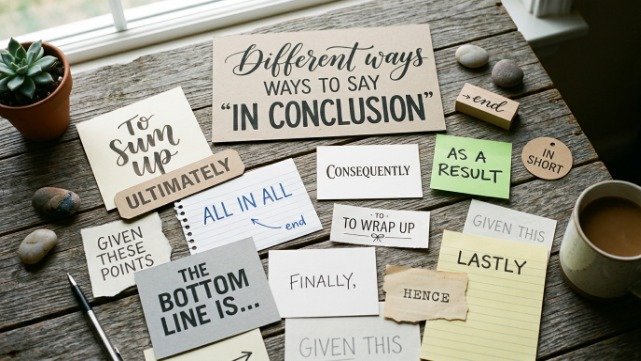
Many people use “in conclusion” at the end of essays, speeches, emails, presentations, and articles. While it works well, repeating the same phrase every time can make your writing sound dull and predictable.
Learning a different way to say in conclusion helps your writing sound more natural, professional, and engaging.If you’re writing a school paper, business report, blog post, or giving a speech, choosing the right closing phrase leaves a stronger final impression.
In this guide, you’ll discover more than “80 alternatives to in conclusion“, organized by different situations. You’ll also learn when to use each type and how to end your writing with confidence.
Different Ways to Say In Conclusion in Formal Writing
Formal writing needs clear and professional closing phrases. These alternatives work well for essays, reports, academic papers, research projects, and business documents.
Examples
- To summarize
- To sum up
- In summary
- In closing
- Overall
- All things considered
- Ultimately
- Taking everything into account
- On the whole
- In the final analysis
- As a final point
- To conclude
- In the end
- In brief
- In short
- To wrap up
- Considering all factors
- After reviewing the evidence
- Based on the information above
- Looking at the overall picture
- In light of these points
- Therefore
- Thus
- Hence
- As a result
Different Ways to Say In Conclusion for Conversations and Everyday Communication
When speaking with friends, coworkers, or family, you don’t always need formal language. These phrases sound more relaxed and natural.
Examples
- At the end of the day
- So basically
- Long story short
- That’s the bottom line
- That’s about it
- That’s all there is to it
- When it all comes down to it
- All in all
- So in the end
- That’s my final thought
- To finish up
- Before I go
- One last thing
- That’s the main idea
- That’s what it comes down to
- Simply put
- To keep it simple
- In simple terms
- That’s the takeaway
- The key point is
- Here’s the final thought
- So yeah
- That’s everything
- That’s my opinion
- That’s my conclusion
Creative and Engaging Ways to Say In Conclusion
If you’re writing blogs, storytelling content, speeches, or motivational pieces, a creative ending keeps readers interested.
Examples
- The final takeaway
- Here’s what matters most
- The biggest lesson is
- Let’s leave it here
- The journey ends here
- One final reminder
- The heart of the matter
- The last word
- Here’s the big picture
- The final chapter
- The ending thought
- What we’ve learned
- The key lesson
- The final piece of the puzzle
- The closing thought
- Let’s bring it all together
- Time to wrap things up
- The final message
- One thing to remember
- The most important point
- Let’s end on this note
- Here’s the conclusion
- The story ends with this
- Let’s finish strong
- The final insight
Different Ways to Say In Conclusion in Academic Essays and Research Papers
When writing essays, dissertations, or research papers, your conclusion should sound polished and logical. These alternatives help you wrap up your ideas while maintaining an academic tone.
Examples
- Based on the findings
- As demonstrated above
- As discussed
- The evidence suggests
- From this analysis
- As shown throughout
- In review
- To conclude this discussion
- From these observations
- It is clear that
- Given these points
- In consideration of the evidence
- Drawing everything together
- The overall findings indicate
- After careful analysis
- Considering the research
- The discussion shows
- The results confirm
- The key conclusion is
- The central idea remains
- Looking back at the evidence
- The facts support
- This leads to the conclusion
- These findings highlight
- The final assessment is
Different Ways to Say In Conclusion for Business Emails and Professional Communication
Professional communication benefits from clear and respectful closing statements. These phrases work well in emails, reports, proposals, and meetings.
Examples
- To finalize
- To close
- As a final note
- Before we conclude
- In closing
- To recap
- To summarize our discussion
- The main takeaway is
- Moving forward
- With that in mind
- Going forward
- To finish
- In the interest of clarity
- The final recommendation is
- Our conclusion is
- The next step is
- To bring this together
- This concludes the report
- Thank you for your time
- We appreciate your attention
- To end
- The final decision is
- In conclusion to this matter
- We can conclude that
- With these points in mind
Different Ways to Say In Conclusion for Speeches and Presentations
A strong ending helps your audience remember your message. Use these phrases to finish speeches, seminars, and presentations with confidence.
Examples
- Before I leave you
- Let me end with this
- I’d like to finish by saying
- As we wrap up
- Let’s end on a high note
- The final message is
- Remember this
- Keep this in mind
- One final thought
- Let me leave you with this idea
- As we conclude today
- To close today’s presentation
- Here’s the biggest takeaway
- The most important lesson is
- Thank you for listening
- Let’s finish here
- Before we finish
- I’ll end with this
- To conclude today’s talk
- Let this be your takeaway
- Think about this
- Let’s bring this session to a close
- I hope you’ll remember this
- That’s the message I want to leave with you
- Thank you for your attention
Different Ways to Say In Conclusion for Blogs and Online Content
Blog posts should end with friendly and engaging language that encourages readers to keep reading or take action.
Examples
- To wrap things up
- Here’s the takeaway
- Let’s recap
- Before you go
- The bottom line
- The key takeaway
- That’s a wrap
- Let’s bring it home
- Here’s the final word
- The final tip
- One last reminder
- Keep these ideas in mind
- That’s what you need to know
- Now it’s your turn
- Hopefully this helps
- Thanks for reading
- Let’s end here
- Remember these tips
- Here’s what to remember
- That’s the complete guide
- We hope you found this useful
- Time to put these ideas into practice
- Start using these phrases today
- The choice is yours
- See you in the next guide
Short and Quick Alternatives to In Conclusion
Need a simple closing phrase? These short options are perfect for emails, assignments, presentations, and quick summaries.
Examples
- Finally
- Overall
- In short
- In brief
- To sum up
- In summary
- Ultimately
- Simply
- Therefore
- Thus
- Hence
- So
- Last
- Lastly
- All in all
- Bottom line
- Final thought
- Briefly
- To finish
- Wrap up
- End result
- Main point
- Final note
- In closing
- That’s it
Tips for Choosing the Best Alternative to In Conclusion
Choosing the right ending phrase depends on your audience and purpose. Keep these tips in mind:
- Match the tone to your audience. Formal writing needs professional phrases, while conversations can be more casual.
- Avoid using the same closing phrase in every article or essay.
- Keep your conclusion short and focused on the main idea.
- Make sure your ending connects naturally with the rest of your writing.
- Choose a phrase that fits your personality and writing style.
Conclusion
Using a different way to say in conclusion can instantly improve your writing and speaking. If you’re finishing an essay, presentation, email, blog post, or casual conversation, the right closing phrase makes your message more memorable and professional.
Try different alternatives depending on the situation, audience, and tone. The more variety you use, the more confident and engaging your communication becomes.
Which alternative do you use most often? Try a few new ones in your next piece of writing and see how much smoother your conclusion feels.
Discover More Article
- 🚀 Another Way to Say Emphasize: Professional, Creative, and Simple Alternatives (2026)
- ✨ Another Way to Say Based On: Smart Alternatives for Every Situation (2026)
- 🔥 Another Way to Say Impact: Smart Alternatives That Make Your Writing Stronger (2026)

I am Joseph Conrad, a passionate writer with 5 years of experience exploring English grammar, writing tips, and unique ways to improve communication. At my site, Othirway.com, I share practical advice and creative insights to help readers enhance their language skills and express themselves more effectively.