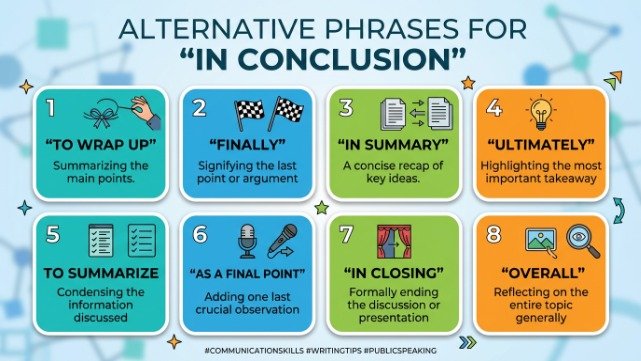
Have you ever finished writing an essay, email, speech, or blog post and realized you keep using the same phrase: “in conclusion“? While it’s a clear way to wrap up your thoughts, repeating it too often can make your writing sound dull and predictable.
The good news is that there are many better ways to end your writing.If you’re working on a school assignment, a business report, a presentation, or a casual blog, choosing the right closing phrase can make your message sound more natural, professional, and engaging.
In this guide, you’ll discover “80+ alternatives to in conclusion“, organized by different situations so you can easily find the perfect phrase for your writing.
Formal Writing and Academic Papers
When writing essays, reports, research papers, or professional documents, your conclusion should sound polished and confident. These alternatives work well in formal writing.
- To summarize
- To sum up
- Overall
- All things considered
- In summary
- Ultimately
- In closing
- On the whole
- Taking everything into account
- In the final analysis
- To conclude
- As a final point
- In the end
- In retrospect
- Therefore
- Thus
- As demonstrated
- As discussed
- Given these points
- Based on the evidence
- From this analysis
- As shown above
- Considering all factors
- The key takeaway is
- The evidence suggests
Professional Emails and Workplace Communication
Business emails and workplace conversations often need a smooth ending without sounding overly formal. These phrases help you finish professionally.
- In short
- To wrap things up
- The bottom line is
- In brief
- Looking ahead
- With that said
- The main point is
- All in all
- To finish
- At the end of the day
- In closing
- That’s the overview
- The final thought is
- To recap
- Moving forward
- This means
- Going forward
- The conclusion is clear
- To bring everything together
- The takeaway is
- In essence
- The result is
- Overall speaking
- The final result
- With these points in mind
Creative Writing, Speeches, and Personal Conversations
Not every conclusion has to sound serious. If you’re telling a story, giving a speech, writing a blog, or chatting with friends, these alternatives feel more natural and engaging.
- So there you have it
- That wraps it up
- And that’s that
- That’s the whole story
- Here’s the big picture
- The lesson is
- The moral of the story is
- At the heart of it all
- What matters most is
- One last thought
- Before we finish
- Here’s the final takeaway
- The important thing is
- Remember this
- Keep this in mind
- In the bigger picture
- It all comes down to this
- That’s what it means
- That’s my final thought
- In the grand scheme of things
- After all
- That’s why it matters
- Simply put
- To leave you with this thought
- That’s the key message
Another Way to Say In Conclusion for Emails and Business Writing
Whether you’re writing a client email, business proposal, or workplace message, these alternatives help you end professionally without sounding repetitive.
- To wrap up
- In closing
- To summarize
- As a final note
- Before we conclude
- Looking ahead
- Moving forward
- With that in mind
- The key takeaway is
- Overall
- In short
- The bottom line is
- To bring everything together
- In brief
- As discussed
- Thank you for your time
- We appreciate your attention
- I look forward to your response
- Please let me know if you have questions
- I hope this helps
- Thank you for considering this
- Together, we can move forward
- I appreciate your support
- Wishing you continued success
- Best wishes moving forward
Another Way to Say In Conclusion for Everyday Conversations
You don’t always need formal words to end a conversation. These casual alternatives sound friendly and natural in daily chats.
- So that’s it
- That’s about it
- That’s the gist
- Long story short
- In the end
- That’s what it comes down to
- That’s the main idea
- That’s all
- Anyway
- So yeah
- All in all
- At the end of the day
- That’s the takeaway
- That’s the point
- Simply put
- The important thing is
- That’s why
- That’s how it is
- That’s everything
- Hope that makes sense
- That’s my take
- That’s what I think
- So there you go
- That’s the whole picture
- And that’s the final word
Short Alternatives for Quick Conclusions
Sometimes you only need a brief phrase to end your writing. These short alternatives are perfect for quick summaries.
- Finally
- Overall
- Thus
- Therefore
- Ultimately
- In short
- In brief
- Simply put
- To sum up
- All in all
- Bottom line
- In essence
- So
- Hence
- Accordingly
- As a result
- To conclude
- Last
- In closing
- Briefly
- All things considered
- End result
- Final thought
- Key takeaway
- That’s all
Tips for Using Alternatives to In Conclusion
- Choose a phrase that matches your audience and writing style.
- Use formal alternatives for essays, reports, and business documents.
- Pick conversational phrases for blogs, speeches, and personal writing.
- Avoid using the same ending phrase in every piece of writing.
- Make sure your conclusion summarizes your main point instead of introducing new ideas.
Conclusion
Using a better alternative to “in conclusion” can instantly improve your writing.If you’re finishing an academic paper, sending a professional email, writing a blog, or giving a speech, the right closing phrase helps your message feel stronger and more memorable.
Try different alternatives based on your audience, tone, and purpose. A small change at the end of your writing can leave a lasting impression.
Which alternative do you use most often? Try one of these options in your next piece of writing and see how much smoother your conclusion sounds.
Discover More Article
- ✍️ Another Way to Say According to:Smart Alternatives for Better Writing (2026)
- Another Word for States in an Essay 💡 Strong Words Every Student Should Know (2026)
- ✨ Another Way to Say Based On: Smart Alternatives for Every Situation (2026)

I am Rudyard Kipling, a passionate writer with 7 years of experience. I create engaging content on English grammar, writing tips, and unique language insights. Through my website, othirway.com, I aim to help readers improve their writing skills and explore creative ways to express themselves effectively.